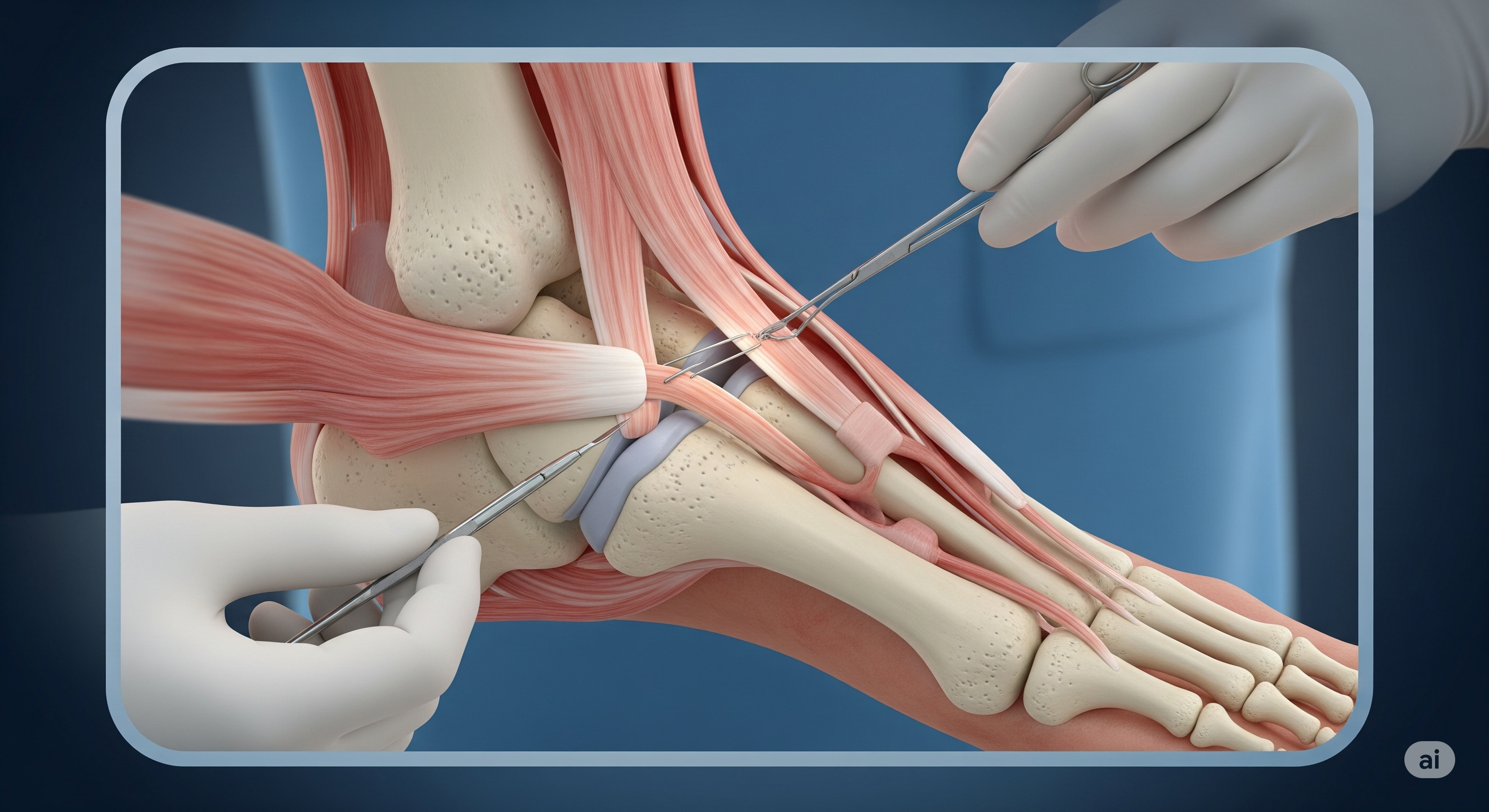
Ankle Sprain Surgery
🦶 Ankle Sprain Surgery
🔹 What It Is
Most ankle sprains heal with rest, ice, compression, elevation (RICE), physiotherapy, and sometimes a brace or cast.
👉 But in severe cases, where ligaments are badly torn or ankle is unstable, surgery may be required.
🔹 When Surgery Is Needed
. Surgery is usually considered if:
. Chronic ankle instability → ankle keeps giving way after multiple sprains.
. Severe ligament tear (Grade III sprain, complete rupture).
. Failure of 6+ months of non-surgical treatment (physiotherapy, bracing).
. Associated injuries → fractures, cartilage damage.
. Athletes or active people needing strong ankle stability.
🔹 Types of Ankle Sprain Surgery
1.Arthroscopy
. A small camera (arthroscope) is inserted.
. Removes loose cartilage, scar tissue, or bone fragments.
. Often combined with ligament repair.
2.Ligament Repair (Broström Procedure)
. Torn ligaments (usually ATFL – anterior talofibular ligament) are stitched back together.
. Sometimes reinforced with nearby tissue.
3.Ligament Reconstruction
. If ligament too damaged to repair.
. Uses tendon graft (from patient or donor) to rebuild the ligament.
. Provides strong and stable ankle.
🔹 Risks of Surgery
⚠️ Infection.
⚠️ Nerve injury → numbness or tingling.
⚠️ Stiffness.
⚠️ Blood clots.
⚠️ Failure to restore full stability (rare with modern methods).
🔹 Recovery Timeline
. Hospital stay: Usually same day or 1 night.
. Initial rest & splint/cast: 2–3 weeks.
. Walking with boot or brace: 4–6 weeks.
. Physiotherapy: starts around week 3–4.
. Return to sports: 3–6 months (depends on severity & type of surgery).
🔹 Outcomes
. Most patients regain excellent stability and return to daily activities.
. Athletes often get back to pre-injury performance after proper rehab.

 AI
Gene
AI
Gene